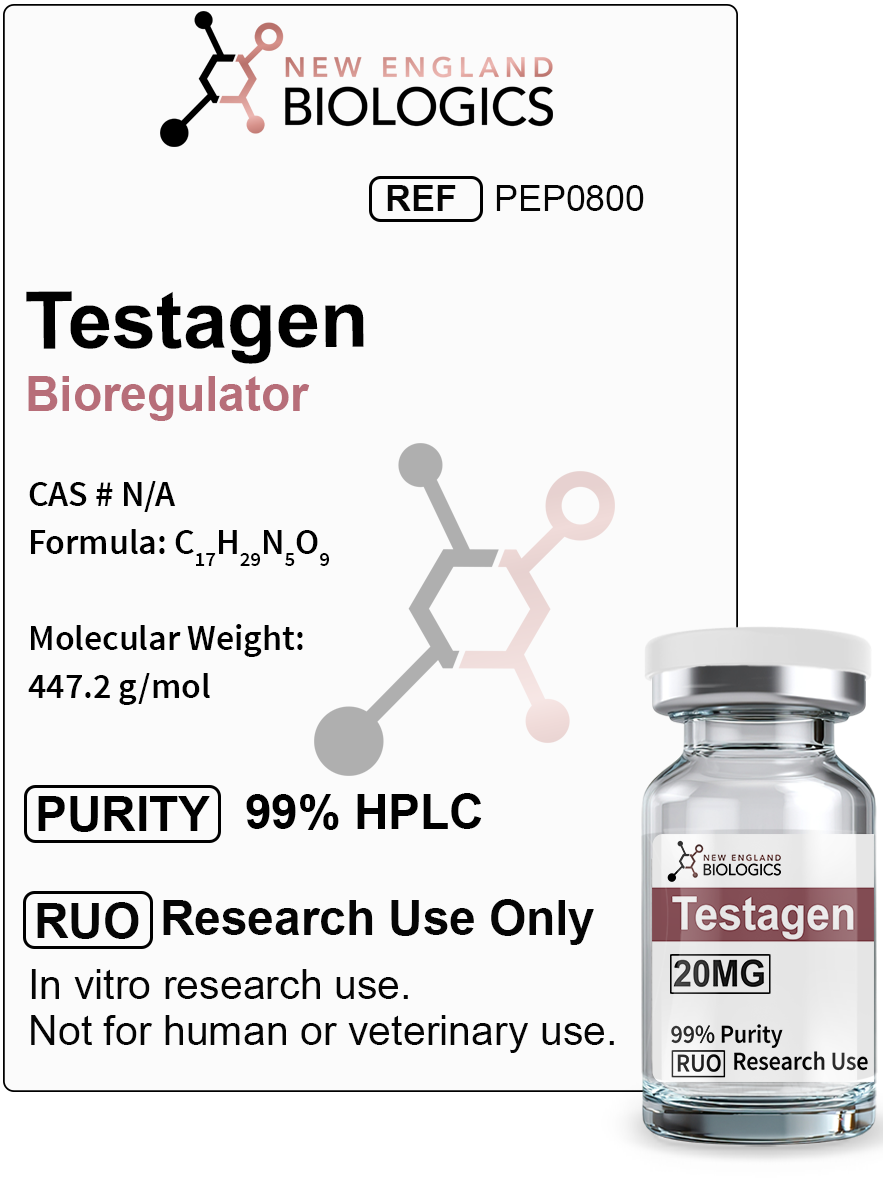
Testosterone Production and Male Reproductive Health
Clinical research demonstrates Testagen's effects on testosterone synthesis and male endocrine function. A controlled clinical trial involving 36 patients with chronic abacterial prostatitis and androgenic deficiency showed that one month of Testagen treatment produced marked improvements in uroflowmetric parameters, significant reductions in prostate inflammation markers, and measurable increases in serum total testosterone levels. The study documented that treatment protocols combining Testagen with standard therapies resulted in superior hormonal outcomes compared to conventional approaches alone.
Research suggests Testagen promotes testosterone biosynthesis by stimulating Leydig cell activity within testicular tissue, the primary site of testosterone production in males. The peptide appears to enhance cellular metabolism in reproductive organs while supporting the transcriptional activity of RNA and DNA polymerases, mechanisms that facilitate protein formation and cellular regeneration necessary for optimal gonadal function. Studies in animal models indicate that Testagen treatment in older subjects led to improved testis morphology, more youthful behavioral patterns, and better maintenance of muscle mass, effects likely mediated through enhanced androgen production.
The peptide's influence extends to the broader hypothalamic-pituitary-gonadal axis, where it may optimize the coordinated release of gonadotropin-releasing hormone (GnRH), luteinizing hormone (LH), and follicle-stimulating hormone (FSH). This integrated regulatory effect helps restore normal communication within endocrine pathways that govern spermatogenesis, sexual function, and overall reproductive balance in male physiology.
Sources:
- Rossikhin VV, Hoshchenko YO, Osipov PG. Efficacy of testosterone synthesis inductor application "Testagen" in androgenic deficiency in patients with chronic abacterial prostatitis. Problems of Endocrine Pathology. 2011;36(2):17-22. https://doi.org/10.21856/j-PEP.2011.2.03
- Khavinson V, Linkova N, Diatlova A, Trofimova S. Peptide Regulation of Cell Differentiation. Stem Cell Reviews and Reports. 2020;16(1):118-125. https://doi.org/10.1007/s12015-019-09938-8
Thyroid Function and Metabolic Regulation
Testagen demonstrates significant effects on thyroid gland morphology and hormonal function in experimental models. Research using hypophysectomized avian subjects showed that Testagen administration prevented atrophic changes in the thyroid gland and significantly increased levels of thyroid-stimulating hormone (TSH), triiodothyronine (T3), and thyroxine (T4). These hormonal improvements were accompanied by structural preservation of thyroid tissue, including normalized follicle size, prevention of colloid accumulation, and maintenance of healthy thyrocyte morphology.
Studies document that hypophysectomy typically induces severe thyroid dysfunction, including enlarged follicles, flattened epithelial cells, and dramatically reduced thyroid hormone concentrations. Testagen treatment counteracted these pathological changes by apparently 23% increases in body weight, modest augmentation of thyroid gland weight, and restoration of normal follicular architecture. The peptide exhibited stimulating effects on thyroid capsule growth and prevented the epithelial flattening characteristic of thyroid atrophy.
Importantly, research reveals age-dependent efficacy patterns, with restoration of thyroid functions and morphology being significantly greater in one-year-old subjects compared to five-year-old subjects. This finding suggests Testagen may work through developmental regulatory pathways that remain more responsive in younger biological systems, though therapeutic benefits were observed across age groups. The peptide's effects on thyroid function appear to operate independently of direct pituitary support, indicating it may directly modulate protein expression patterns within thyroid tissue itself.
Sources:
- Kuznik BI, Pateyuk AV, Rusaeva NS, Baranchugova LM, Obydenko VI. Effects of peptides Lys-Glu-Asp-Gly and Ala-Glu-Asp-Gly on hormonal activity and structure of the thyroid gland in hypophysectomized young chickens and old hens. Bulletin of Experimental Biology and Medicine. 2011;150(4):495-499. https://doi.org/10.1007/s10517-011-1177-3
- Kuznik BI, Pateyuk AV, Rusaeva NS, Baranchugova LM, Obydenko VI. The effect of Lys-Glu-Asp-Gly and Ala-Glu-Asp-Gly peptides on hormone activity and the thyroid structure in sexually mature and old hypophysectomized birds. Advances in Gerontology. 2011;1:340-345. https://doi.org/10.1134/S2079057011040072
- Kuznik BI, Pateiuk AV, Rusaeva NS, Baranchugova LM, Obydenko VI. Effects of hypophyseal Lys-Glu-Asp-Gly and Ala-Glu-Asp-Gly synthetic peptides on immunity, hemostasis, morphology and functions of the thyroid gland in neonatally hypophysectomized chicken and one-year-old birds. Advances in Gerontology. 2011;24(1):93-98. https://pubmed.ncbi.nlm.nih.gov/20731122/
Cellular Differentiation and Stem Cell Function
Research demonstrates Testagen's role in regulating stem cell differentiation and preventing cellular senescence. Studies on human mesenchymal stem cells show that peptides in the KED family (including Testagen's KED tripeptide component) significantly decrease expression of senescence markers p16 and p21 by 1.82 to 3.23-fold compared to control groups. These effects were confirmed through both quantitative gene expression analysis and immunofluorescent visualization, indicating Testagen helps maintain stem cell populations in a more youthful, functionally competent state during long-term cultivation.
Testagen demonstrates particular efficacy in promoting neuronal differentiation of stem cells. Research using human periodontal ligament stem cells and gingival mesenchymal stem cells shows that treatment with peptides containing the KED sequence upregulates expression of neuronal differentiation markers including nestin, GAP43, β-tubulin III, and doublecortin. These effects suggest Testagen can guide pluripotent cells toward specific lineage commitments, a property valuable for regenerative medicine applications and tissue repair processes.
The peptide also stimulates differentiation of immune cells, with studies identifying KED and KEDG peptides as activators of immunogenic differentiation pathways. This broad spectrum of differentiation-promoting activities across multiple cell lineages—including neural, immune, and mesenchymal tissues—positions Testagen as a versatile bioregulator capable of supporting diverse regenerative processes. The geroprotective properties demonstrated in stem cell studies suggest potential applications in maintaining tissue homeostasis and combating age-related decline in cellular function.
Sources:
- Sinjari B, Diomede F, Khavinson V, Mironova E, Linkova N, Trofimova S, Trubiani O, Caputi S. Short Peptides Protect Oral Stem Cells from Ageing. Stem Cell Reviews and Reports. 2020;16:543-555. https://doi.org/10.1007/s12015-019-09921-3
- Caputi S, Trubiani O, Sinjari B, Trofimova S, Diomede F, Linkova N, Diatlova A, Khavinson V. Effect of short peptides on neuronal differentiation of stem cells. International Journal of Immunopathology and Pharmacology. 2019;33:2058738419828613. https://doi.org/10.1177/2058738419828613
- Khavinson V, Linkova N, Diatlova A, Trofimova S. Peptide Regulation of Cell Differentiation. Stem Cell Reviews and Reports. 2020;16(1):118-125. https://doi.org/10.1007/s12015-019-09938-8
Epigenetic Gene Regulation and DNA Interactions
Testagen's molecular mechanism involves direct interactions with chromatin structures and DNA regulatory regions. Research demonstrates that fluorescence-labeled short peptides, including those with the KEDG sequence, successfully penetrate cell nuclei and interact specifically with DNA structures. Studies show Testagen binds to histone proteins—particularly to regions with specific conformational structures—suggesting a role in modulating chromatin accessibility and gene transcription.
The peptide's interaction with histones involves unique spatial complementarity rather than sequence-specific binding, allowing it to influence the conformational and functional state of chromatin broadly. This binding mechanism enables Testagen to affect gene activity and cellular differentiation through epigenetic pathways that don't alter the underlying DNA sequence but rather modulate how genes are accessed and expressed. Research indicates these peptide-histone complexes influence gene transcription, DNA replication, repair processes, and other cellular functions governed by chromatin structure.
Systematic reviews of peptide bioregulation identify KEDG as one of several short peptides capable of regulating gene expression across diverse biological systems including plants, microorganisms, insects, birds, rodents, and humans. Studies document that structurally similar peptides in this family regulate expression of 36 to 98 different genes, suggesting Testagen may influence multiple genetic pathways simultaneously. The peptide's effects extend to regulation of DNA methylation status, an epigenetic mechanism for gene activation or repression that plays crucial roles in normal physiological function, pathological states, and aging processes.
Sources:
- Fedoreyeva LI, Kireev II, Khavinson VK, Vanyushin BF. Penetration of short fluorescence-labeled peptides into the nucleus in HeLa cells and in vitro specific interaction of the peptides with deoxyribooligonucleotides and DNA. Biochemistry (Moscow). 2011;76(11):1210-1219. https://doi.org/10.1134/S0006297911110022
- Fedoreyeva LI, Smirnova TA, Kolomijtseva GY, Khavinson VK, Vanyushin BF. Interaction of short peptides with FITC-labeled wheat histones and their complexes with deoxyribooligonucleotides. Biochemistry (Moscow). 2013;78:166-175. https://doi.org/10.1134/S0006297913020053
- Khavinson VK, Popovich IG, Linkova NS, Mironova ES, Ilina AR. Peptide Regulation of Gene Expression: A Systematic Review. Molecules. 2021;26(22):7053. https://doi.org/10.3390/molecules26227053
Disclaimer: The research articles listed above are for informational purposes only.
This product is intended for research use only and not for human or veterinary use.