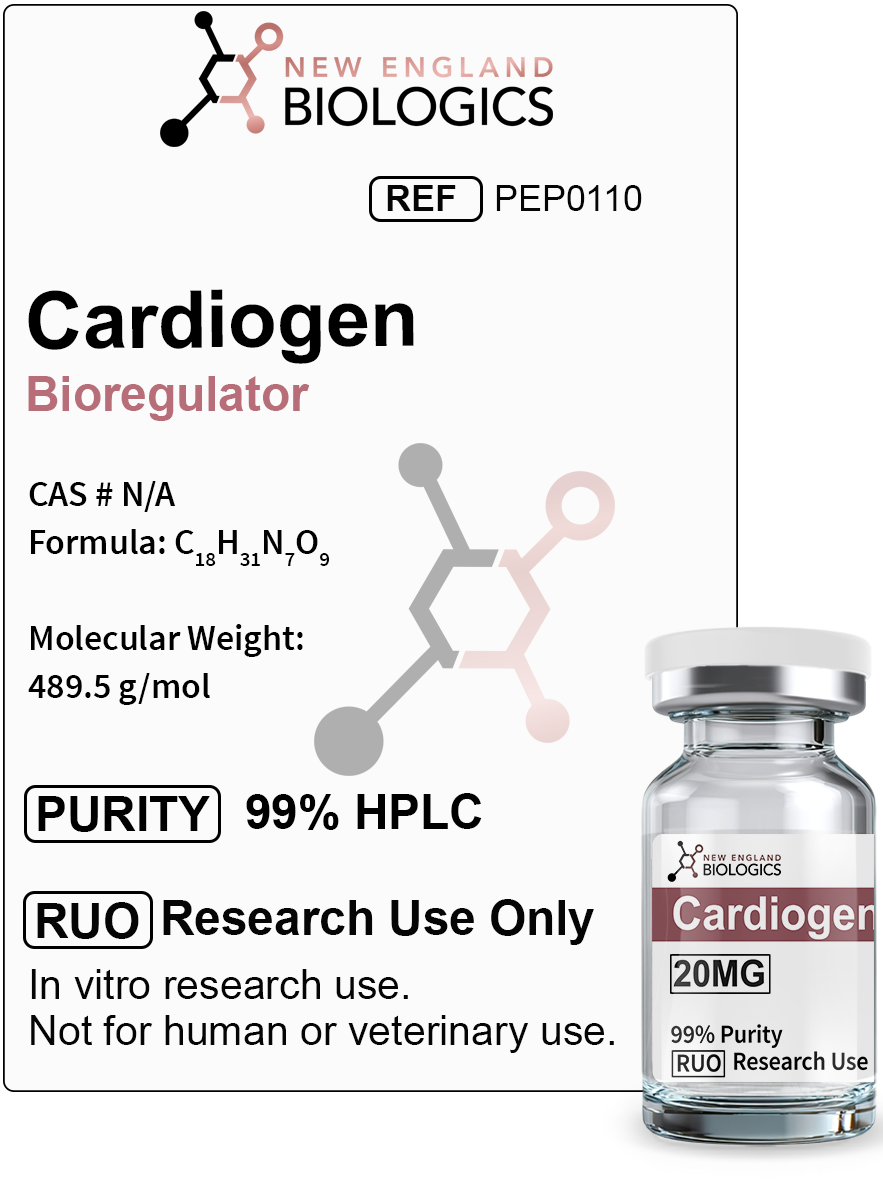
Cardiovascular Function and Tissue Repair
Research demonstrates that Cardiogen exerts significant protective effects on cardiovascular tissue through multiple complementary mechanisms. In controlled studies using myocardial tissue explants from rats at different ages (3 months and 24 months), Cardiogen administered at picomolar concentrations (10⁻¹² M) significantly stimulated cell proliferation in cardiac tissue from both young and aged animals. Notably, while only 7 of 20 individual amino acids showed proliferative effects in young rat tissue and only 2 in aged tissue, Cardiogen demonstrated robust stimulating effects across both age groups, indicating maintained efficacy even in senescent tissue where natural regenerative capacity is diminished.
The peptide's cardioprotective activity operates through activation of cytoskeletal and nuclear matrix protein synthesis. Experimental studies using embryonic fibroblasts demonstrate that Cardiogen increases expression of cytoplasmic proteins actin, vimentin, and tubulin by up to 5-fold compared to control groups, while nuclear matrix proteins lamin A and lamin C showed increases of approximately 2.5-fold. This enhanced synthesis of structural proteins contributes to improved cellular stability and resistance to mechanical and metabolic stress.
Immunohistochemical analysis reveals that Cardiogen treatment decreases p53 protein expression in myocardial tissue, providing evidence for the peptide's antiapoptotic properties. The p53 protein, often termed the "guardian of the genome," triggers programmed cell death when activated. By reducing p53 expression, Cardiogen inhibits the apoptosis process in myocardial tissue, thereby preserving functional cardiac cells during periods of stress, injury, or ischemia. This mechanism is particularly significant for maintaining cardiac function following myocardial infarction or during chronic heart failure progression.
Sources:
- Chalisova NI, Lesniak VV, Balykina NA, Urt'eva SA, Urt'eva TA, Sukhonos IuA, Zhekalov AN. [The effect of the amino acids and cardiogen on the development of myocard tissue culture from young and old rats]. Advances in Gerontology. 2009;22(3):409-13. https://pubmed.ncbi.nlm.nih.gov/20210190/
- Khavinson VK, Linkova NS, Polyakova VO, Kheifets OV, Tarnovskaya SI, Kvetnoy IM. [Peptidergic regulation of the expression of signal factors of fibroblast differentiation in the human prostate gland in cell aging]. Bulletin of Experimental Biology and Medicine. 2012 May;153(1):148-51. https://pubmed.ncbi.nlm.nih.gov/22808515/
Fibroblast Regulation and Extracellular Matrix Modulation
Cardiogen demonstrates critical regulatory effects on cardiac fibroblasts—cells primarily responsible for extracellular matrix (ECM) production and tissue repair following cardiac injury. The cardiac ECM, composed predominantly of collagen types I (85%) and III (11%), provides structural integrity but can lead to pathological fibrosis when excessively deposited. Research indicates that Cardiogen modulates fibroblast behavior to promote balanced tissue repair while limiting maladaptive scar formation.
Studies on aging fibroblast cultures demonstrate that Cardiogen enhances expression of key signaling factors including CXCL12, WEDC1, and ghrelin—proteins crucial for fibroblast differentiation whose synthesis significantly declines in senescent cultures. Treatment with Cardiogen restored expression of these factors in older cell cultures (after 7 passages) to levels exceeding those of young controls (after 1 passage), suggesting the peptide's capacity to reverse age-related declines in fibroblast function.
The peptide influences ECM protein synthesis, promoting production of collagen and elastin in amounts appropriate for tissue repair while preventing the excessive collagen deposition characteristic of pathological cardiac fibrosis. This regulatory action appears to involve modulation of the balance between matrix metalloproteinases (MMPs)—enzymes that degrade ECM proteins—and their inhibitors (TIMPs), thereby supporting physiological ECM turnover rather than pathological accumulation.
Research suggests Cardiogen stimulates cardiomyocyte proliferation while simultaneously reducing fibroblast proliferation and maturation into myofibroblasts—the activated state responsible for excessive collagen production. This dual action creates a more favorable cellular ratio for cardiac tissue regeneration, potentially improving long-term outcomes in cardiac remodeling scenarios that might otherwise progress to congestive heart failure. The peptide's influence on cytoskeletal proteins (actin, vimentin, tubulin) in fibroblasts may contribute to maintenance of appropriate cell morphology and contractile properties necessary for organized tissue architecture.
Sources:
- Khavinson VKh, Linkova NS, Polyakova VO, Kheifets OV, Tarnovskaya SI, Kvetnoy IM. [Peptidergic regulation of the expression of signal factors of fibroblast differentiation in the human prostate gland in cell aging]. Bulletin of Experimental Biology and Medicine. 2012 May;153(1):148-51. https://pubmed.ncbi.nlm.nih.gov/22808515/
- Khavinson VK, Popovich IG, Linkova NS, Mironova ES, Ilina AR. Peptide Regulation of Gene Expression: A Systematic Review. Molecules. 2021 Nov 22;26(22):7053. https://pmc.ncbi.nlm.nih.gov/articles/PMC8619776/
Cellular Protection and Gene Expression Regulation
Cardiogen operates through sophisticated molecular mechanisms involving direct interaction with DNA and histone proteins to regulate gene expression. Research demonstrates that the peptide can bind to specific nucleotide sequences in DNA, particularly in promoter regions of genes involved in cardiovascular function, cellular stress response, and tissue repair processes. This binding occurs through interactions with both major and minor grooves of double-stranded DNA, with the peptide showing preferential affinity for specific sequence motifs.
Studies using fluorescence quenching analysis reveal that Cardiogen binds to histone proteins H1, H2B, H3, and H4 in the N-terminal regions containing peptide-binding motifs. This interaction influences chromatin structure and gene accessibility, functioning as an epigenetic regulatory mechanism. The peptide's ability to modulate histone-DNA complexes enables it to influence which genes are expressed or repressed, providing a molecular explanation for its tissue-specific biological effects.
The peptide regulates intracellular metabolism and induces cell proliferation and differentiation by modulating DNA-associated proteins including enzymes and transcription factors. This regulation increases the accessibility of genes encoding cytoskeletal proteins for transcription, thereby activating metabolic pathways essential for cardiac tissue maintenance and repair. The enhanced synthesis of lamin A and C proteins observed with Cardiogen treatment serves as a molecular indicator of the peptide's antiapoptotic activity, as these nuclear envelope proteins are critical for nuclear stability and cellular survival under stress conditions.
Cardiogen's influence extends to regulation of oxidative stress responses and mitochondrial function in cardiac cells. The peptide's ability to activate stress-response pathways while inhibiting inappropriate apoptosis creates a cellular environment conducive to survival and function during metabolic challenges. This is particularly relevant for aged cardiac tissue, where accumulated oxidative damage and mitochondrial dysfunction contribute to declining cardiac performance.
Sources:
- Chalisova NI, Lesniak VV, Balykina NA, Urt'eva SA, Urt'eva TA, Sukhonos IuA, Zhekalov AN. [The effect of the amino acids and cardiogen on the development of myocard tissue culture from young and old rats]. Advances in Gerontology. 2009;22(3):409-13. https://pubmed.ncbi.nlm.nih.gov/20210190/
- Khavinson VK, Popovich IG, Linkova NS, Mironova ES, Ilina AR. Peptide Regulation of Gene Expression: A Systematic Review. Molecules. 2021 Nov 22;26(22):7053. https://pmc.ncbi.nlm.nih.gov/articles/PMC8619776/
Anti-Tumor Effects and Cellular Selectivity
Research reveals that Cardiogen exhibits differential effects on normal versus tumor cells, demonstrating tumor-modifying properties in experimental cancer models. Studies using senescent rats with transplanted M-1 sarcoma showed that Cardiogen treatment produced dose-dependent inhibition of tumor growth. The level of apoptosis in tumor cells following Cardiogen injections was significantly higher than in control groups across all experimental conditions, indicating the peptide's capacity to selectively induce programmed cell death in malignant tissue.
The tumor-inhibiting effects of Cardiogen appear mediated through development of hemorrhagic necrosis and stimulation of tumor cell apoptosis rather than direct cytostatic action. Morphological analysis indicates that the mechanism of Cardiogen's anti-tumor activity operates through the tumor's vascular network, suggesting the peptide may influence tumor blood supply or endothelial cell function in a manner unfavorable to tumor growth. Parameters of proliferative activity demonstrated that tumor growth inhibition was not caused by direct suppression of cell division but rather through vascular-mediated mechanisms and enhanced apoptotic signaling.
This tumor-selective action stands in stark contrast to Cardiogen's protective effects in normal cardiac tissue, where the peptide reduces apoptosis and promotes cell survival. The differential response suggests that Cardiogen may recognize molecular or structural differences between normal and transformed cells, potentially responding to altered chromatin structure, aberrant gene expression patterns, or metabolic differences characteristic of cancer cells. This selectivity represents a significant finding, as most compounds that promote apoptosis do so nonspecifically, affecting both healthy and malignant cells.
The peptide's concentration-dependent effects on tumor cells, combined with its tissue-protective properties in normal cardiac tissue, suggest potential applications in scenarios where both cardiovascular protection and tumor growth inhibition are desired. However, the precise molecular mechanisms governing Cardiogen's ability to distinguish between normal and malignant cells require further investigation to fully elucidate the signaling pathways and cellular checkpoints involved in this selective action.
Sources:
Disclaimer: The research articles listed above are for informational purposes only.
This product is intended for research use only and not for human or veterinary use.