Wound Healing and Tissue Repair
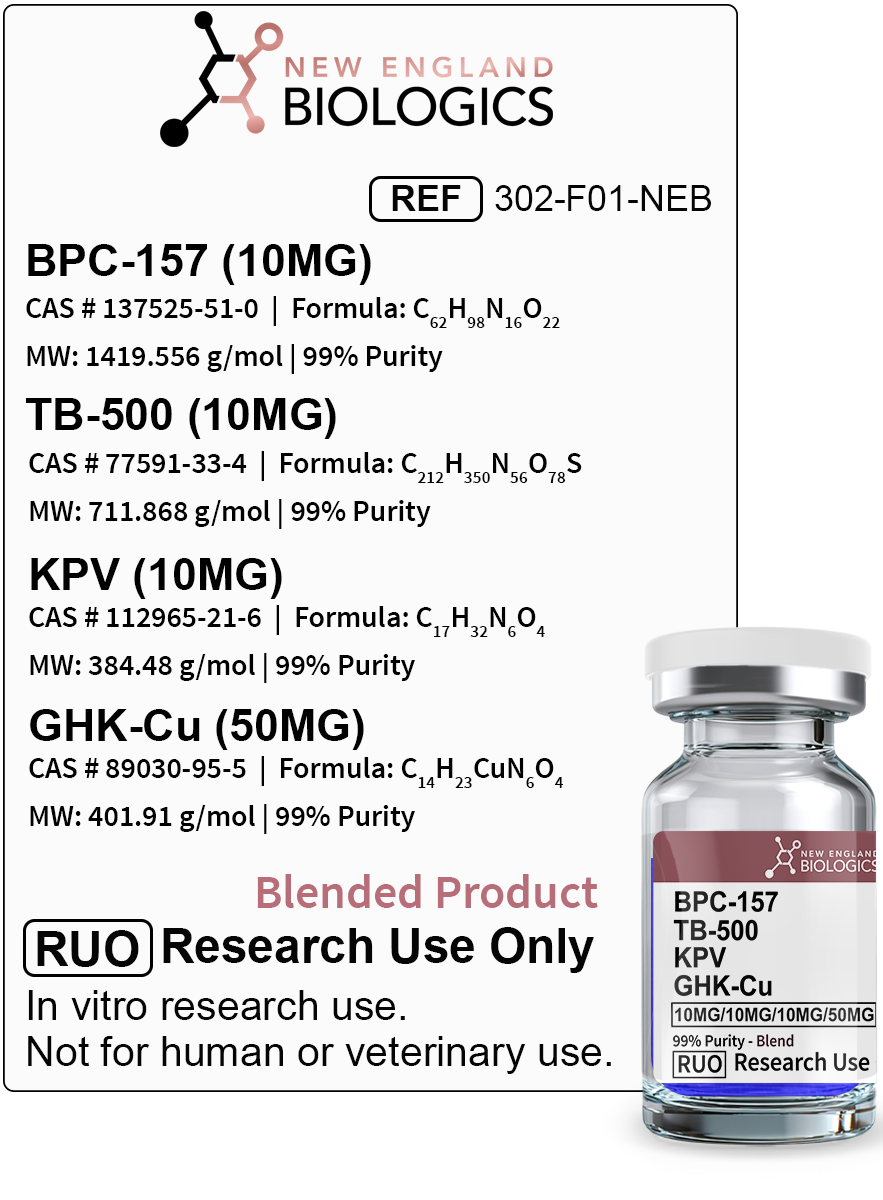
Preclinical research has examined each component's effects on wound closure rates and tissue restoration in animal models. In rabbit studies, GHK-Cu treatment was associated with wound contraction and granulation tissue formation. Rat studies using peptide-incorporated collagen dressings reported 9-fold increases in collagen content compared to controls. Research also documented elevated glutathione and ascorbic acid levels in GHK-Cu treated wounds.
Animal studies of BPC-157 report wound closure improvements ranging from 14-50% compared to untreated controls across various wound models. In alkali-burn studies, BPC-157-treated wounds showed comparable effects to basic fibroblast growth factor (bFGF) treatments. Histological analyses documented earlier appearance of collagen deposition, inflammatory cell activity, and angiogenesis markers in BPC-157-treated tissues.
TB-500 research in full-thickness wound models reports re-epithelialization rates increased by 42% at day 4 and 61% at day 7 compared to saline controls. Studies documented increased collagen deposition and wound contraction of approximately 11% by day 7. Keratinocyte migration assays showed 2-3-fold increases with concentrations as low as 10 picograms of TB-500.
KPV studies report antimicrobial activity with approximately 90% of Staphylococcus aureus cells killed within 15 minutes of peptide exposure. Wound healing models incorporating KPV documented effects on inflammation markers, angiogenesis parameters, and collagen deposition, with studies conducted in both healthy and diabetic animal models.
Sources:
Tendon, Ligament, and Musculoskeletal Repair
Research has investigated these peptides in connective tissue injury models. BPC-157 studies using transected rat Achilles tendons report effects on tendon outgrowth, fibroblast survival under oxidative stress conditions, and dose-dependent increases in fibroblast migration. Studies documented growth factor upregulation and cellular migration patterns to injury sites.
TB-500 research in tendon models reports promotion of tendon explant outgrowth and increased survival of tendon-derived fibroblasts exposed to hydrogen peroxide. Transwell filter migration assays documented enhanced fibroblast migration. Phase II human trials of thymosin beta-4 (TB-500's parent molecule) have been conducted examining tissue repair rates, though detailed results remain limited in peer-reviewed literature.
GHK-Cu research examines effects on collagen synthesis and extracellular matrix remodeling in various tissue types. Studies investigate the peptide's interactions with metalloproteinase activity during tissue remodeling phases. Research also documents GHK-Cu's effects on angiogenesis markers in tissue models with limited vascular supply.
KPV studies examine anti-inflammatory effects during acute injury phases. Macrophage model research reports reductions in TNF-α expression following KPV treatment. Studies investigate the peptide's effects on NF-κB activation and cytokine production profiles in inflammatory conditions.
Sources:
- Chang CH, et al. The promoting effect of pentadecapeptide BPC 157 on tendon healing involves tendon outgrowth, cell survival, and cell migration. Journal of Applied Physiology. 2011;110(3):774-780. https://journals.physiology.org/doi/full/10.1152/japplphysiol.00945.2010
- Goldstein AL, et al. Thymosin β4: a multi-functional regenerative peptide. Basic properties and clinical applications. Expert Opinion on Biological Therapy. 2012;12(1):37-51.
- Pickart L, et al. GHK Peptide as a Natural Modulator of Multiple Cellular Pathways in Skin Regeneration. BioMed Research International. 2015;2015:648108. https://pmc.ncbi.nlm.nih.gov/articles/PMC4508379/
- Singh M, et al. Melanocortin-derived tripeptide KPV has anti-inflammatory potential in murine models of inflammatory bowel disease. Inflammatory Bowel Diseases. 2008;14(3):324-331.
Angiogenesis and Vascular Formation
Research has examined these peptides' effects on new blood vessel formation in various tissue models. GHK-Cu studies document increased expression of VEGF and bFGF in treated tissues. Research investigates the peptide's effects on blood flow restoration through angiogenesis, anticoagulation, and vasodilation mechanisms. Studies also examine GHK-Cu's effects on collagen and elastin synthesis in blood vessel structures.
BPC-157 research investigates VEGFR2 activation and nitric oxide production through Akt-eNOS pathway interactions. Studies document NO production effects on endothelial proliferation and vessel dilation. Research tracks VEGF expression, factor VIII, and CD34 marker patterns in wound models, with peak expression documented in early healing intervals.
TB-500 studies examine epicardial progenitor cell mobilization and neovascularization processes. Research documents morphological changes in epicardial tissue following TB-500 administration. Wound healing studies report increased blood vessel formation in treated tissues, with sponge implantation assays comparing angiogenic effects to standard agents.
KPV research examines the peptide's indirect effects on vascular health through inflammatory pathway modulation. Studies investigate how inflammatory reduction affects neovascularization processes during tissue repair.
Sources:
- Pickart L, Margolina A. The Human Tripeptide GHK-Cu in Prevention of Oxidative Stress and Degenerative Conditions of Aging: Implications for Cognitive Health. Oxidative Medicine and Cellular Longevity. 2012;2012:324832. https://pmc.ncbi.nlm.nih.gov/articles/PMC3359723/
- Murphy JA, et al. Regeneration or Risk? A Narrative Review of BPC-157 for Musculoskeletal Healing. Sports Health. 2024;16(6):883-895. https://pmc.ncbi.nlm.nih.gov/articles/PMC12446177/
- Smart N, et al. Thymosin β4 induces adult epicardial progenitor mobilization and neovascularization. Nature. 2007;445(7124):177-182.
- Xiao L, et al. Orally Targeted Delivery of Tripeptide KPV. ACS Applied Materials & Interfaces. 2017;9(26):22160-22169. https://pmc.ncbi.nlm.nih.gov/articles/PMC5498804/
Anti-Inflammatory Effects and Immune Interactions
Research examines these peptides' interactions with inflammatory pathways. KPV studies document NF-κB pathway inhibition and effects on inflammatory gene expression. Lipopolysaccharide-stimulated macrophage studies report reduced TNF-α mRNA expression with effects maintained for 72-96 hours. IL-1β–stimulated condition studies documented approximately 35% reductions in IL-8 production, with similar patterns observed for IL-6 and IL-1β.
GHK-Cu research investigates effects on oxidative iron release following tissue injury and lipid peroxidation processes. Studies report 75% reduction of lipid peroxidation in gastric mucosa homogenates. Research also examines GHK-Cu's chemoattractant properties for mast cells and macrophages in wound models.
BPC-157 studies investigate cellular stress response modulation and cytokine production patterns. Research documents effects on endothelial integrity and vascular inflammatory responses. Studies track inflammatory cell infiltration patterns in various tissue injury models.
TB-500 research examines cellular migration patterns and their relationship to inflammatory resolution. Studies investigate mast cell mediator release and tissue organization patterns in healing wounds. Research documents inflammation markers in TB-500-treated versus control tissues.
Sources:
- Xiao L, et al. Orally Targeted Delivery of Tripeptide KPV via Hyaluronic Acid-Functionalized Nanoparticles Efficiently Alleviates Ulcerative Colitis. ACS Applied Materials & Interfaces. 2017;9(26):22160-22169. https://pmc.ncbi.nlm.nih.gov/articles/PMC5498804/
- Pickart L, Margolina A. The Human Tripeptide GHK-Cu in Prevention of Oxidative Stress. Oxidative Medicine and Cellular Longevity. 2012;2012:324832. https://pmc.ncbi.nlm.nih.gov/articles/PMC3359723/
- Gwyer D, et al. Gastric pentadecapeptide body protection compound BPC 157 and its role in accelerating musculoskeletal soft tissue healing. Cellular and Molecular Life Sciences. 2019;76(8):1627-1636.
- Ehrlich HP, et al. Thymosin beta4 and thymosin beta4-derived peptides induce mast cell exocytosis. International Journal of Immunopharmacology. 2007;7(3):363-370. https://www.sciencedirect.com/science/article/abs/pii/S019697810700006X
Collagen Synthesis and Matrix Organization
Research has investigated these peptides' effects on collagen production and extracellular matrix formation. GHK-Cu studies examine the peptide's effects on both collagen synthesis and breakdown processes in fibroblast cultures. Research documents stimulation of multiple matrix components including collagen, dermatan sulfate, chondroitin sulfate, and decorin. Wound studies report 9-fold increases in collagen content with GHK-Cu treatment compared to controls. Research also investigates GHK-Cu effects on fibroblast function following radiation exposure.
BPC-157 research examines early growth response gene-1 (egr-1) upregulation and its relationship to collagen organization timing. Comparative studies with platelet-derived growth factor (PDGF-BB) document differences in granulation tissue maturation and collagen organization patterns. Studies measure soluble collagen concentrations in wound exudates and assess organizational patterns at day 12 healing timepoints.
TB-500 studies document collagen deposition levels and tensile strength measurements in treated versus control wounds. Research investigates fibroblast migration patterns and their effects on collagen-producing cell distribution at injury sites. Studies measure mechanical properties of healing tissues including risk factors for wound dehiscence.
KPV research examines the peptide's effects on collagen organization patterns through inflammatory pathway modulation. Studies investigate scar formation patterns, including hypertrophic scarring and keloid formation markers. Research documents collagen metabolism parameters at wound sites following KPV treatment.
Sources:
- Pickart L, et al. GHK Peptide as a Natural Modulator of Multiple Cellular Pathways in Skin Regeneration. BioMed Research International. 2015;2015:648108. https://pmc.ncbi.nlm.nih.gov/articles/PMC4508379/
- Tkalcevic VI, et al. Enhancement by PL 14736 of granulation and collagen organization in healing wounds and the potential role of egr-1 expression. European Journal of Pharmacology. 2007;570(1-3):212-221.
- Malinda KM, et al. Thymosin β4 accelerates wound healing. Journal of Investigative Dermatology. 1999;113(3):364-368. https://pubmed.ncbi.nlm.nih.gov/10469335/
- Luger TA, Böhm M. Are melanocortin peptides future therapeutics for cutaneous wound healing? Experimental Dermatology. 2019;28(S1):20-25.